Investing 101: How to build a portfolio that fits you

Don't invest unless you're prepared to lose all the money you invest. This is a high-risk investment and you're unlikely to be protected if something goes wrong. Take 2 mins to see our risk warning.
Most people start investing in the wrong place. They hear about a stock, a fund or a property deal, and the first question they ask is “how much will it make?”
The better first question is “how much can I afford to put away, and for how long?” Get that right, and choosing what to invest in becomes far simpler.
One in ten UK adults has no cash savings at all, and a further 21% have less than £1,000 to fall back on in an emergency (FCA, 2025). At the other end, 61% of people with more than £10,000 to invest hold at least three-quarters of it in cash (FCA, 2025). Both groups are exposed, just in different ways.
This guide works through the process in the order we would follow ourselves:
Before picking a single investment, you need a number. It has two parts: what you have today, and what you can add each month.
Investable = Cash today + (Income – Expenditure) – Rainy day fund
Cash today is money sitting in current and savings accounts that is not already earmarked for something, such as a car next year or a wedding in the summer.
Income less expenditure is your monthly surplus. Be honest here. Look at three months of bank statements rather than guessing, because most of us underestimate what we spend.
The rainy day fund comes off the top. We cover how big it should be in Step 3.
Worked example: Sara has £20,000 in savings. She takes home £3,500 a month and spends £2,700, leaving £800. Her essential costs are £2,200 a month, so a three-month rainy day fund is £6,600. That leaves her £13,400 to invest today, plus £800 a month going forward.
The monthly figure matters as much as the lump sum. Regular investing over many years is how most ordinary portfolios are built.
Around 39% of UK adults carry unsecured debt, with a median balance of £2,500 (FCA, 2025). Before investing, it is worth deciding how you will treat it.
Not all debt is equal. Expensive short-term borrowing, such as credit cards, car finance or buy-now-pay-later, should almost always be cleared first. Few investments reliably beat the cost of a credit card, and for Muslim investors there is the added concern of interest-bearing debt in the first place.
Home finance is a genuine choice, and sensible people land on both sides of it.
| Pay off home finance early | Invest while paying it down | |
| The case for | The roof over your head is yours outright. Less rent or profit paid to the bank over the term. A big drop in monthly outgoings once it is done. | Your money starts compounding and growing years earlier. You keep cash accessible rather than locked in bricks. You build a spread of assets, not just one. |
| The case against | Investing starts later, so you lose years of growth. Most of your wealth sits in one property in one town. | You keep paying the bank for longer. Your monthly commitments stay higher, so a job loss bites harder. |
There is no right answer here. Some people simply sleep better knowing they can never be made homeless. Others would rather have their money working across several assets.
A middle path is common: overpay modestly on the home finance while investing the rest of your monthly surplus.
A rainy day fund is cash set aside purely for emergencies. It is not an investment. Its job is to stop you having to sell investments at the worst possible moment.
The usual guide is three months of essential spending, stretching to six months if your income is less certain: you are self-employed, the sole earner, or work in an industry prone to layoffs.
Why bother? Because you never know what is round the corner. You could lose your job. A recession could hit just as markets fall. The roof could need replacing. Without a buffer, each of these forces you to sell investments, often at a loss, or borrow. In 2024, 9% of UK adults could cover their living costs for less than a week if they lost their main income (FCA, 2025).
Where to keep it. The money needs to be safe and available within a day or two. A sharia-compliant easy-access savings account does the job. Options include QIB (UK), Al Rayan Bank and Gatehouse Bank, with a Cur8 Savings product launching soon. Deposits with UK-authorised banks are protected by the FSCS up to £120,000 per person, per bank (Raisin, 2026).
Once Steps 1 to 3 are done, what is left is money you can genuinely afford to invest.
There is no single right portfolio. A 25-year-old can take more risk because, if things go badly, they have 30+ years of earning ahead to recover. Someone about to retire does not have that cushion and will usually want something steadier.
Four questions do most of the work in deciding what suits you:
Looking at the two ends of each question shows how much the answers shape a portfolio:
| Question | One end | Points towards | Other end | Points towards |
| Risk appetite | Low | Cash savings, income funds | High | Private equity, venture capital |
| Income or growth | Need income now (e.g. retiring) | Income funds, rental property | Happy to wait for growth | Private equity, venture capital, global shares |
| Liquidity | Need access within months | Cash, public markets, income funds | Can lock in for 5+ years | Private equity, venture capital |
| Time horizon | Under 5 years | Cash, income funds | 15+ years | Shares, private equity, venture capital |
Most people sit somewhere in the middle on each, and the answers change as life does. Revisit them every few years, or after a big event like a new job, a child or an inheritance.
Diversification means spreading your money so that no single event can damage all of it at once. It is one of the few ways to lower risk without automatically giving up return.
The gap between how most people invest and how the very wealthy invest shows this starkly:
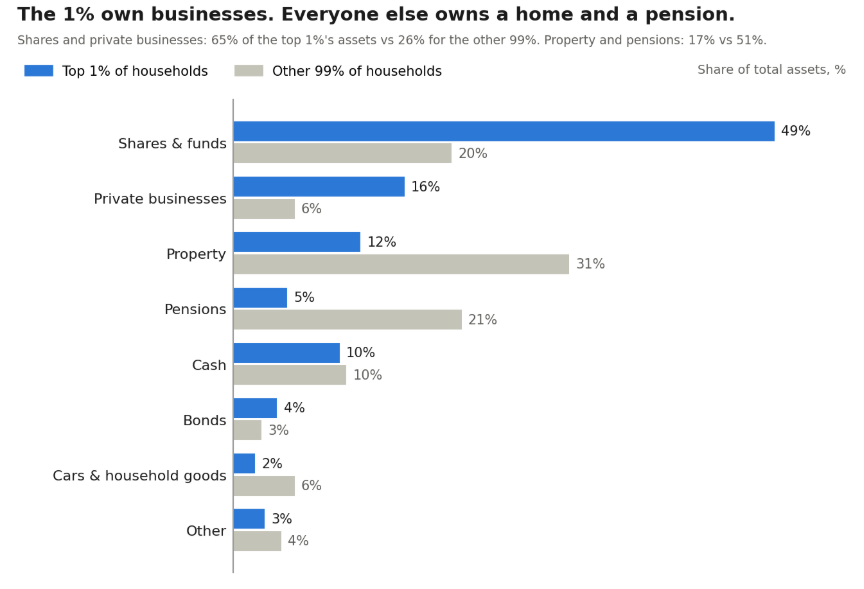
Source: Federal Reserve, Distributional Financial Accounts, Q1 2026 (released June 2026). US households, share of total assets. Tier figures as tabulated by Axis Intelligence Research; top 1% and other 99% combined by Cur8 Capital, weighted by each group’s total assets. ‘Shares & funds’ includes stakes in privately held companies.
The difference is not just how much the wealthy own, but what they own. Almost two-thirds of the top 1%’s assets are stakes in businesses, through shares and private companies. For the other 99%, half of everything they own is their home and their pension (Federal Reserve, 2026). Surveys of the very wealthy show the same tilt: members of TIGER 21, a network of ultra-high-net-worth investors, now hold a record 34% of their portfolios in private equity (TIGER 21, 2026).
There are good reasons for the gap. Private markets have historically needed large minimums and the right connections. The wealthy can also afford to lock money away for years, and they expect to be paid extra for doing so. And a spread of business stakes means their wealth grows with the wider economy, rather than resting mostly on the value of one house.
What happens when you don’t diversify. On 2 April 2025, President Trump announced sweeping “Liberation Day” tariffs. Two days later the FTSE 100 fell 4.95% in a single session, its worst day since March 2020 (PA Media, 2025). Someone holding only a FTSE tracker felt all of it. That same month, gold hit a new all-time high (Schroders, 2025). Someone holding both saw one part of their portfolio cushion the other.
The chart below shows the best and worst year for each type of investment over the last ten years, and for a simple mix of them:
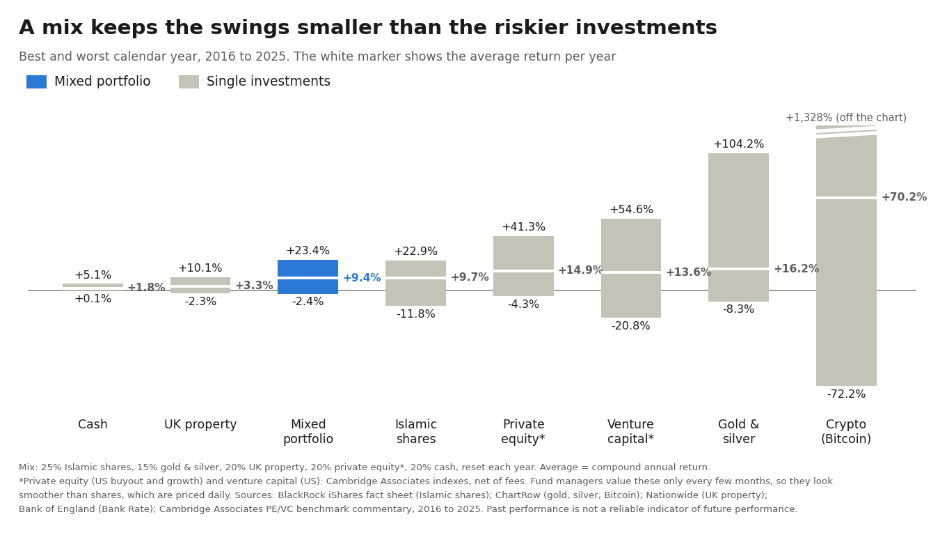
No single investment was safe in every way. Cash never lost money, but it averaged under 2% a year. Bitcoin, gold and silver, and venture capital had some of the biggest gains, but Bitcoin and venture capital also had some of the deepest falls. Islamic shares averaged 9.7% a year, but lost 11.8% in their worst year.
In 2022 for example, shares, private equity, venture capital, and Bitcoin all fell, while UK property, cash, and gold and silver held up. This is the case for diversification. A bad year for one type of investment is often cushioned by the others.
Each asset class does a different job. Some protect what you have, some pay you an income, and some are there to grow over the long run. A good portfolio uses several of them.
Cash savings. Your safest, most accessible money. Returns are modest and may not keep up with inflation, so it is the home for your rainy day fund rather than your long-term wealth. However, you may opt to include this as part of your wider portfolio if you will need the cash soon, or while you wait for the right opportunity to invest into.
Commodities (gold and silver). Gold pays no income, but it has tended to hold its value when currencies and stock markets wobble. It is not risk-free: after rising 64% in 2025, gold fell 27% from its January 2026 peak within weeks (Incrementum, 2026).
Public markets. Shares in listed companies, can be bought directly or through a fund. Easy to buy and sell daily, and the core of most portfolios. Prices can swing sharply year to year.
Income funds. Funds that lend to businesses or property projects and pay out a regular return. For Muslim investors, these are structured on sharia-compliant terms rather than interest.
Real estate. Rental income plus long-term growth in value. Direct property ties up a lot of money in one building; funds and fractional platforms that let you own a small share let you spread smaller sums across several assets.
Private equity. Ownership stakes in established private companies, usually held for five to seven years. Higher target returns, in exchange for locking your money away.
Venture capital. Early-stage start-ups. Many fail, and a few winners pay for the rest. Best kept to a small slice you can afford to lose. UK investors may get significant tax relief through government schemes for start-up investing (EIS and SEIS).
Other alternatives. Crypto, art, antiques, watches. These can be rewarding, but are hard to value, often illiquid and difficult to sell, and in crypto’s case prone to falls of 70% or more in a single year. Treat them as a small part of your portfolio, never the core.
Some asset classes are only accessible dependent upon the pot available to invest. As an example, Private Equity in the conventional space requires a typical minimum investment of £250k, and therefore not all asset classes are accessible to all investors.
| Asset class | Risk | Accessibility | Liquidity | Main job | Examples |
| Cash savings | Low | High | Same day – 1 month | Safety, emergencies | Cur8 Savings (coming soon), QIB (UK), Al Rayan Bank, Gatehouse Bank |
| Commodities | Medium | High | Daily | Hedge against inflation and market shocks | Physically backed gold and silver ETCs |
| Public markets | Medium | High | Daily | Long-term growth | Wahed (e.g. the HLAL ETF), iShares MSCI World Islamic |
| Income funds | Low to medium | Medium | Months | Regular income | Cur8 GBP Income Fund (7.75% target), Cur8 USD Income Fund (9.5% target) |
| Real estate | Medium | Solo – High Fractional/Partnered – Medium | Months | Income plus growth | Nester, Cur8 Capital ad-hoc projects |
| Private equity | Medium to high | High | 5 to 7 years | Capital growth | Cur8 Capital Private Equity (18% target) |
| Venture capital | High | High | 7 to 10 years | High growth, tax relief | Cur8 EIS Venture Fund (20%+ target) |
| Other alternatives | High | Medium | Varies | Satellite bets | Crypto, art, collectibles |
Target returns are targets, not guarantees. Capital is at risk in everything except FSCS-protected cash.
Meet Yusuf. He is 40, married with two children, and has a steady salaried job. He has home finance with 15 years left, no other debts, and a six-month rainy day fund already sitting in an easy-access savings account. He has £50,000 to invest and expects to retire in around 25 years.
His answers to the four questions:
A balanced mix for Yusuf could look like this:
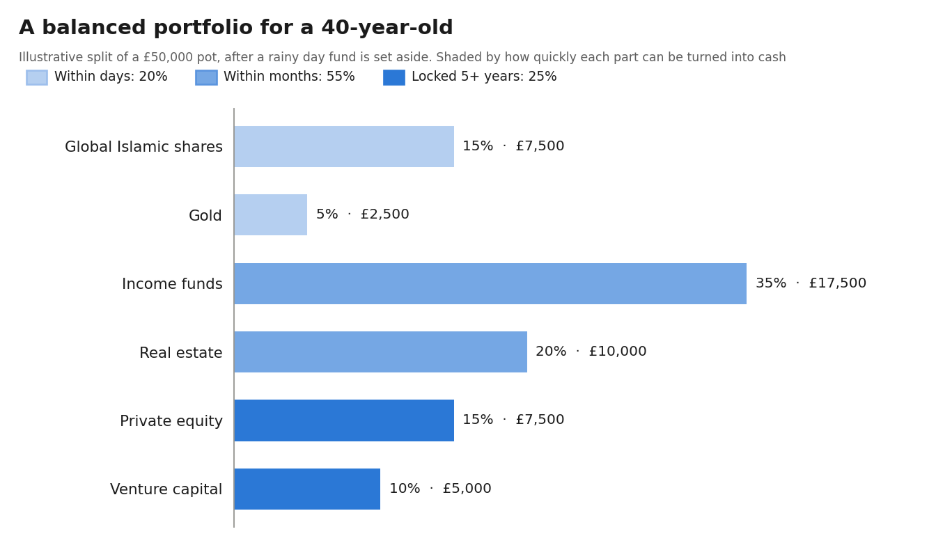
Illustrative allocation only. Not a recommendation.
Why this shape works for him. Private equity and venture capital take 25% of the pot. This is money he will not need for years, so he can capture the higher expected returns that come with locking it away. Income funds and property make up another 55%, adding steady payouts that do not rise and fall with the stock market, with access within months. Global shares and gold are the final fifth and can be sold any day.
Only a fifth of the pot can be reached within days, which is why his separate six-month rainy day fund matters: a surprise expense never forces him to sell anything early. No single asset class is more than 35% of the total.
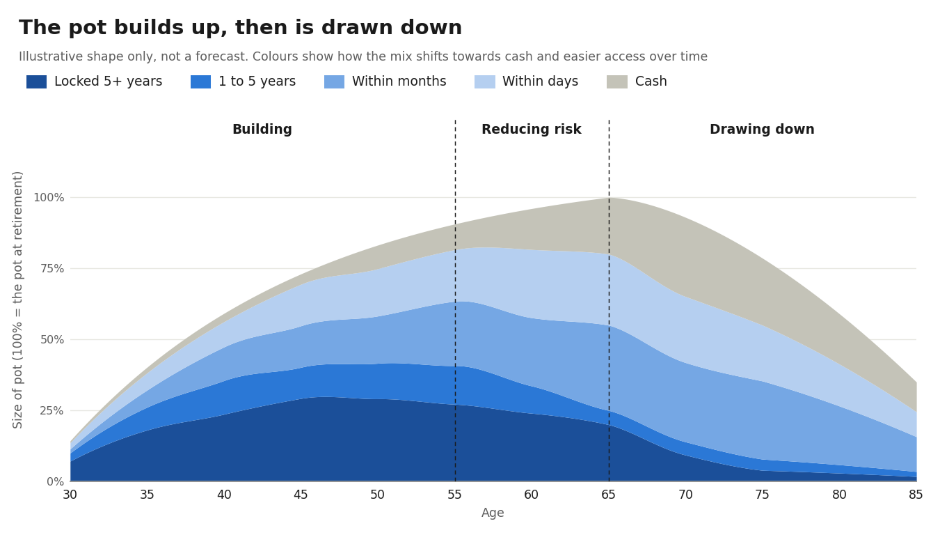
As Yusuf gets closer to retirement, the mix should shift gradually: less in venture capital and private equity, more in income funds and cash.
Owning eight asset classes does not help much if they all depend on the same thing. Spread your money along these lines too.
Sectors. Halal share funds screen out banks, insurers and heavily indebted companies, which leaves them leaning on technology. The top 10 holdings make up 56% of Wahed’s HLAL ETF and 45% of iShares’ USA Islamic fund (fund factsheets, 2025). Owning several halal equity funds can unknowingly be the same bet on the same handful of tech giants.
Countries and currencies. The FTSE 100 fall after the 2025 tariff announcement hit UK investors who held only UK shares. A mix of UK, US, Gulf and emerging-market exposure, in more than one currency, means one government’s decision cannot reach everything you own.
Providers. This is the one most people forget. If one firm holds all your investments and something goes wrong there, every holding is affected at once, however diversified it looked on paper.
Two UK examples show what that looks like:
Neither was simply a case of the wrong asset class or market failures. Investors were let down by the provider. Splitting your money across several regulated firms, and checking that each is FCA-authorised, limits how much any single failure can cost you.
Time. Investing a fixed amount each month, rather than everything on one day, spreads your entry price and takes the guesswork out of timing the market.
Tax optimisations. Other areas of focus include the right mode to invest to achieve the best net returns. Options range from ISA based investing, utilising Pensions (SIPP, SSAS) or through a limited entity. Consideration of zakatable positions of each investment is also another factor investors review.
Every portfolio is different, and it should be. Yusuf’s mix would be wrong for a 25-year-old with no dependents, and wrong again for his parents.
What stays the same is the order of work:
If you have capital of £100,000 or more that you are looking to put to work, you are welcome to book a call with the Cur8 Capital investment team for an overview of available strategies and diversification plays.
Book a call with our investment team →
This article is for educational purposes only and does not constitute financial, tax, legal or investment advice. Capital is at risk. Private market investments can be illiquid and may not be suitable for all investors. Target returns are not guaranteed. Tax treatment depends on individual circumstances and may change. Investors should obtain appropriate professional advice before making investment decisions.